
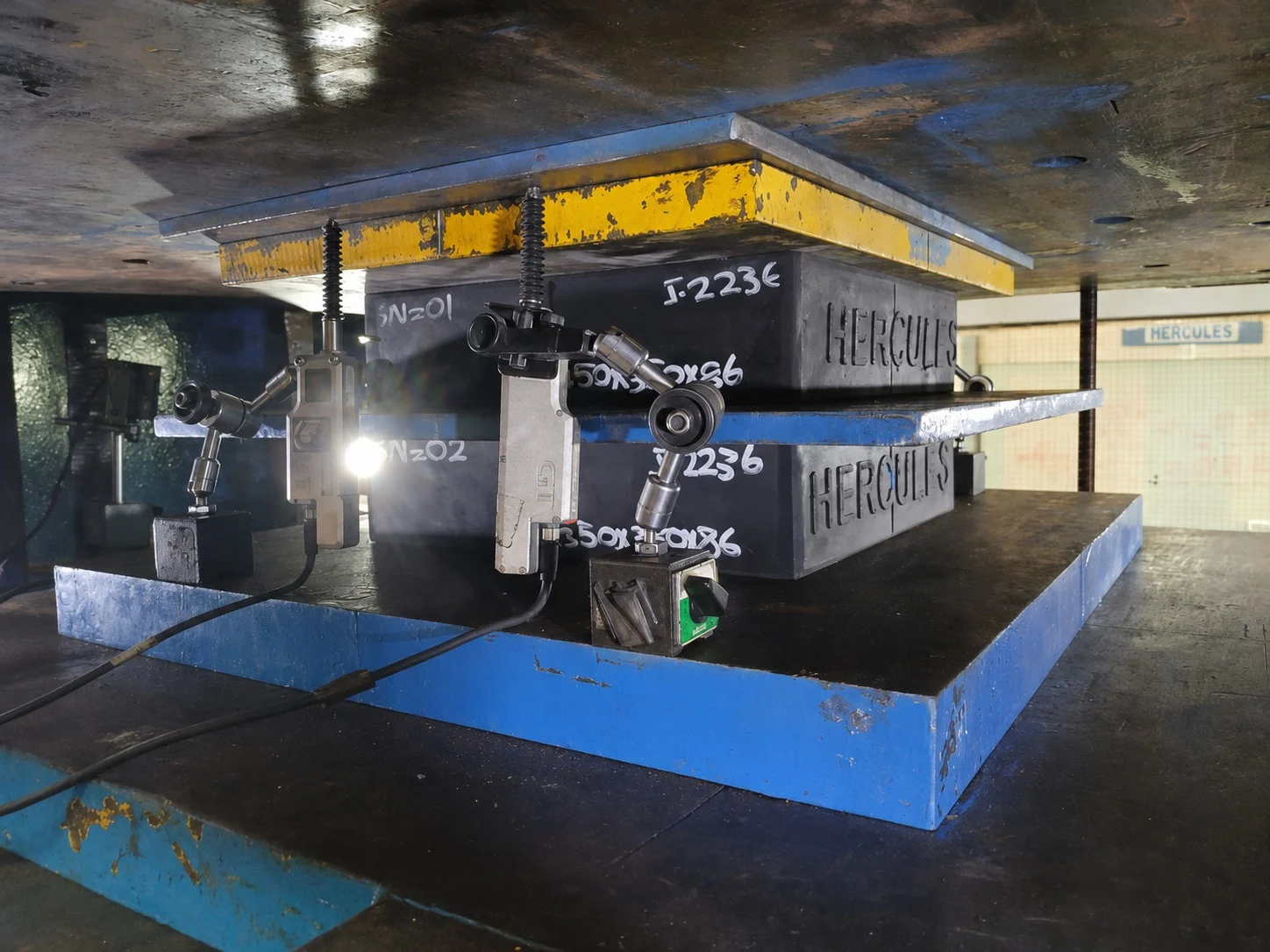
Structural bearings are critical components in bridges and infrastructure projects, transferring loads while accommodating movement, rotation, and thermal expansion. To ensure long-term safety and durability, all AS5100 structural bearings must undergo rigorous compliance testing before installation.
Under AS 5100.4:2017, structural bearings are required to satisfy strict performance, material, and durability criteria. These requirements apply to bearing systems including elastomeric bearings, laminated elastomeric bearings, pot bearings, sliding bearings, and steel structural bearings.
Why Compliance Testing Matters
Structural bearings operate under high compressive loads and repeated movement cycles throughout their service life. Without proper testing, issues such as restricted movement, excessive stress, premature deterioration, or structural cracking can occur. Compliance testing helps verify that the bearing will perform safely under design conditions while meeting project specifications and Australian standards.
Compliance Testing of Bearing Types
For elastomeric and laminated elastomeric bearings, testing focuses primarily on the rubber material properties and bond integrity between steel laminates and elastomer layers. Typical tests include:
- hardness testing
- compression testing
- shear modulus testing
- tensile and elongation testing
- accelerated ageing
- ozone resistance testing
Steel structural bearings require dimensional verification and mechanical performance testing to ensure correct operation under load. Typical tests includes:
- dimensional inspection
- weld inspection and NDT testing
- rotational and movement testing
- friction testing for sliding surfaces
- corrosion protection inspection
Many bridge and infrastructure projects require Factory Acceptance Testing (FAT) before shipment to site. This process may include movement simulation, material verification, coating inspection, and witness testing. Comprehensive documentation is also essential to ensure full traceability and compliance with AS 5100 requirements.
HERCULES i-Lab Research Centre
At HERCULES Structural Systems Australia, compliance and quality assurance for our products are supported through our dedicated i-Lab Research Centre, accredited to MS ISO/IEC 17025. The facility provides specialised testing and verification services for structural bearing systems, including elastomeric material testing, compression testing, shear modulus testing, dimensional inspection, and bearing performance assessment.
Final Thoughts
Proper bearing compliance testing is essential for ensuring the safety, durability, and long-term performance of AS 5100 structural bearings. By combining material verification, load testing, dimensional inspection, and quality assurance procedures, engineers and asset owners can minimise project risk and improve the operational life of critical infrastructure assets. Should you require any compliance testing of products for your project, please get in touch with a member of our team.